A Bond That Is Principally Covalent Will Form
Which type of bond will most likely be found in HBr. For instance the diatomic hydrogen molecule H 2 can be written as HH to indicate the single covalent bond between the two hydrogen atoms.
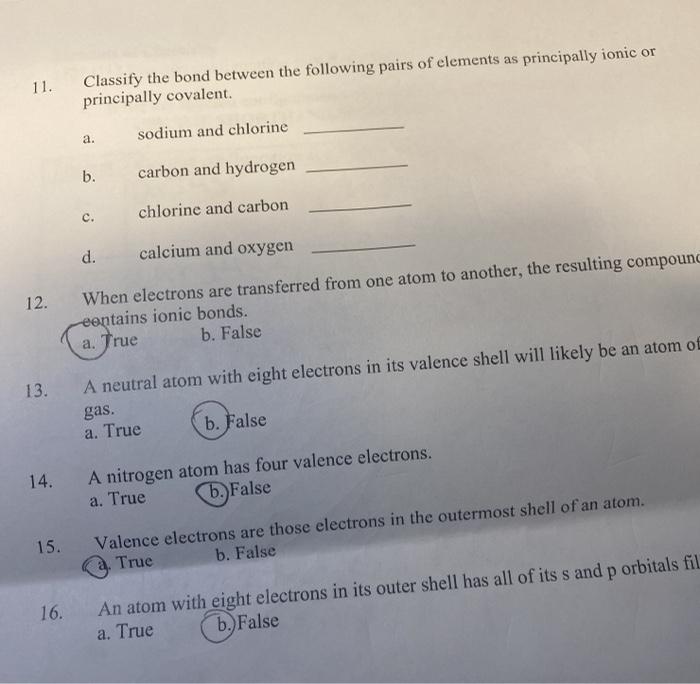
Solved 11 Classify The Bond Between The Following Pairs Of Chegg Com
Potassium and chlorine hydrogen and oxygen chlorine and chlorine carbon and oxygen potassium and oxygen 14.
. B Sodium is metal while chlorine is a non-metal. C Copper is metal while bromine is a non-metal. So ionic bond will be formed by their interaction and the compound NaCl will be an ionic compound.
A covalent bond forms when two or more valence electrons are attracted by the positively charged nuclei of two atoms and thus are shared between both atoms. Magnesium and chlorine b. Non-metal Non-metal Covalent compound.
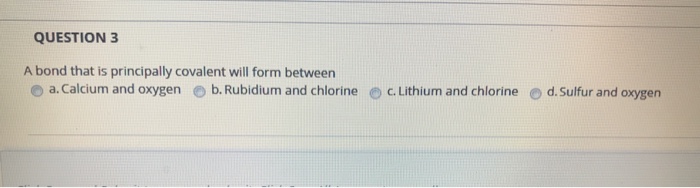
The non-metals involved can be a the elements from Groups 15 16 and 17 of the Periodic Table. Covalent Bonds Homework with Answers 1 Which type of chemical bond involves the equal sharing of. A bond that is principally covalent will form between.
Who are the experts. A bond that is principally covalent will form between fluorine and oxygen 13 an ionic bond will form between which two atoms. Terms in this set 3 When two or more atoms share electrons the bond is _____ Covalent.
A calcium and oxygen b. In a true covalent bond the electronegativity values are the same eg H 2 O 3 although in practice the electronegativity values just need to be closeIf the electron is shared equally between the atoms forming a covalent bond then the bond is said to be nonpolar. Covalent bonds usually form _____ at room temperature.
Have low melting points. In any case it can likewise be seen between non-metals and metals. For example an oxygen atom can bond with another oxygen atom to fill their outer shells.
Usually an electron is. Lewis dot structures are one way to represent how atoms form covalent bonds. A bond that is principally ionic will form between.
A brief treatment of covalent bonds follows. The H2 molecule is stable because each hydrogen atom now has a shared pair of electrons and has achieved a stable noble gas configuration. Covalent bonding generally happens between nonmetals.
Selenium and oxygen d. Covalent bond in chemistry the interatomic linkage that results from the sharing of an electron pair between two atoms. Explain why neon is monatomic but chlorine is diatomic.
Electron pairs shared in a covalent bond are known as shared pairs or bonding pairs and. A covalent bond or molecular bond is a chemical link between two atoms where electron pairs are shared. A covalent bond forms when the bonded atoms have a lower total energy than that of widely separated atoms.
The mutual sharing of two-electron pairs between two atoms forms a double covalent bond. So hydrogen and chlorine will form covalent bonds with each other and the resulting compound HCl will be covalent compound. What is Covalent Bond.
A nonpolar covalent bond. The binding arises from the electrostatic attraction of their nuclei for the same electrons. It symbolises the two atoms sharing electrons by a.
Lithium and chlorine d. Nonpolar covalent bonds form between two atoms of the same element or between different elements that share the electrons equally. This is when the atoms in a molecule are the same and the bonding electrons are shared equally.
Chemistry - Chapter 8 - Covalent Bonding. This holding happens principally between non-metals. The carbon-oxygen bonds are polar covalent.
Which type of bond will form between two chlorine atoms. Contain metals and nonmetals. Eventually a minimum energy is reached thereafter further reduction in r causes energy to increase dramaically principally due to electrostatic repulsion between.
B c and e. There are two types of covalent bonds. Silicon and phosphorus c.
B carbon and silicon from Group 14 of the Periodic Table. Complex Lewis Structures 119. This happens when several atomic orbitals combine to form the same number of equivalent hybrid orbitals.
Covalent bonds form between atoms of nonmetals such as hydrogen and oxygen giving rise to molecules the nanoscale entities that make up molecular compounds. Single covalent bonds occur when one pair of electrons is shared between atoms as part of a molecule or compound. Polar covalent bonding.
It is not as if the two conventional bonds in the CO molecule are stronger or different in any other way than the. We review their content and use your feedback to keep the quality high. The two oxygen atoms are bonded to the carbon atom.
A single covalent bond can be represented by a single line between the two atoms. Covalent bonds form when two nonmetallic atoms have the same or similar electronegativity values. A chlorine atom achieves an octet by sharing an electron with another chlorine atom.
Lewis Structures of Compounds. Some atoms are exceptions to the octet rule by having an expanded octet. Experts are tested by Chegg as specialists in their subject area.
If the atoms that form a covalent bond are identical as in H 2 Cl 2 and other diatomic molecules then the electrons in the bond must be shared equallyWe refer to this as a pure covalent bondElectrons shared in pure covalent bonds have an equal probability of being near each nucleus. Once formed a coordinate covalent bond is the same as any other covalent bond. Covalent bonds are formed when atoms of non-metals combine with each other to form a molecule.
This association is nonpolar because the electrons will be equally. Covalent bonding is the type of bond that holds together the atoms within a polyatomic ion. Which characteristic is needed for an atom to.
Bare often gases or liquids. Neon has an octet of electrons. When two dissimilar nonmetals form bonds eg hydrogen and oxygen they will form a covalent bond but the electrons will spend more.
A bond that is principally ionic will form between a. Each atom offers two electrons for sharing in a double covalent connection. It takes two electrons to make a covalent bond one from each bonding atom.
A polar covalent bond. Rubidium and chlorine c. A table of Lewis dot symbols of nonmetal.
A Increases B Decreases C Remains the same 5 A bond that is principally covalent will form between A Potassium and oxygen B Fluorine and oxygen C Sodium and chlorine D Aluminum and fluorine 6 A bond that is. Sharing Electrons 116. Molecule more stable than two separate hydrogen atoms.
16 Chemistry Vocab-Covalent Bonds. What is waters characteristic shape due to. One of the bonds is a coordinate covalent bond a covalent bond in which one of the atoms contributes both of the electrons in the shared pair.
So if two identical nonmetals eg two hydrogen atoms bond together they will form a pure covalent bond. Covalent bonds form between two non-metal atoms and non-metal compounds that possess the same or similar values of attraction electronegativity. In a covalent bond the atoms are bound by shared electrons.
Which compound contains only nonpolar covalent bonds.
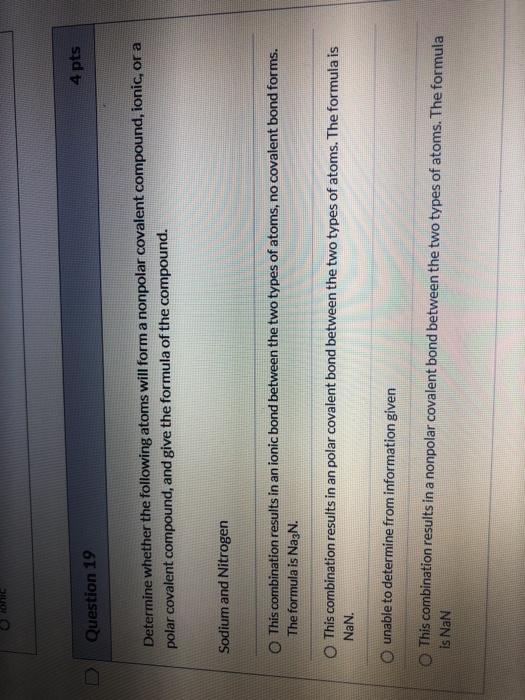
Solved Olonic 4 Pts Question 19 Determine Whether The Chegg Com

Ethiopia Learning Chemistry Grade 9 Page 101 In English
Solved Question 3 A Bond That Is Principally Covalent Will Chegg Com
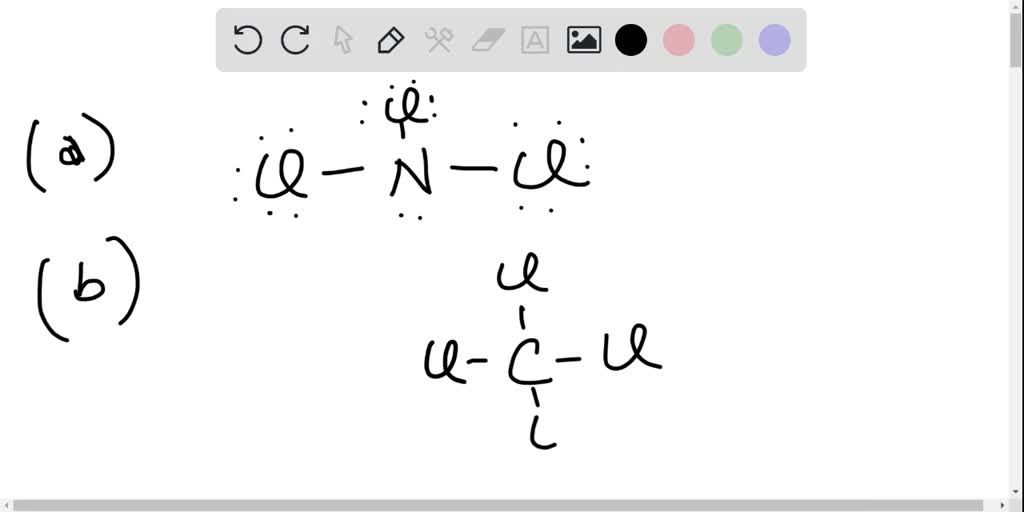
Solved Question 3 Bond That Is Principally Covalent Will Form Between A Calcium And Oxygen B Rubidium And Chlorine Lithium And Chlorine D Sulfur And Oxygen
No comments for "A Bond That Is Principally Covalent Will Form"
Post a Comment